The word pattern carries two things at once. On one side, pattern is tradition and norm, the settled way, the recognisable form that has been laid down often enough to be expected. On the other, pattern is a form of abstraction that lets one begin something without yet knowing what it will be. To start a pattern is not to start a story. A story commits to its ending the moment it begins. A pattern allows a beginning that does not picture its end, because what it offers is return rather than arrival, iteration rather than conclusion. Both senses live in the word, and they pull in different directions. Being patterned is not in itself either of these. The image is a point at which several vectors meet. Production, the procedure that produced it. Presentation, the institutional frame that presents it. Reception, the reading that takes it up. Each of these depends on the image to make meaning, and the meanings they produce vary but are not arbitrary. What the image can be made to mean is constrained by what is in it, by the procedure that put it there, and by the reading that returns to it. Whether the pattern closes or opens depends on the vectors meeting at the surface, and on how each is travelled.
The opening sense is easily obscured. Pattern is often read through the decorative, used in the dismissive way the word has been made to carry, as if pattern were ornament, the visible regularity that pleases without arguing. The apolitical reading lets it stay there. Both privilege what declares itself, what is legible at first pass, and both can miss what abstraction does when it is given room, which is to hold open what cannot yet be put into words or images. The pattern that performs its own legibility has often given up the abstracting work and become illustration of what was thinkable already. The pattern that holds something open is harder to read, and that difficulty is the condition of its keeping anything open at all.
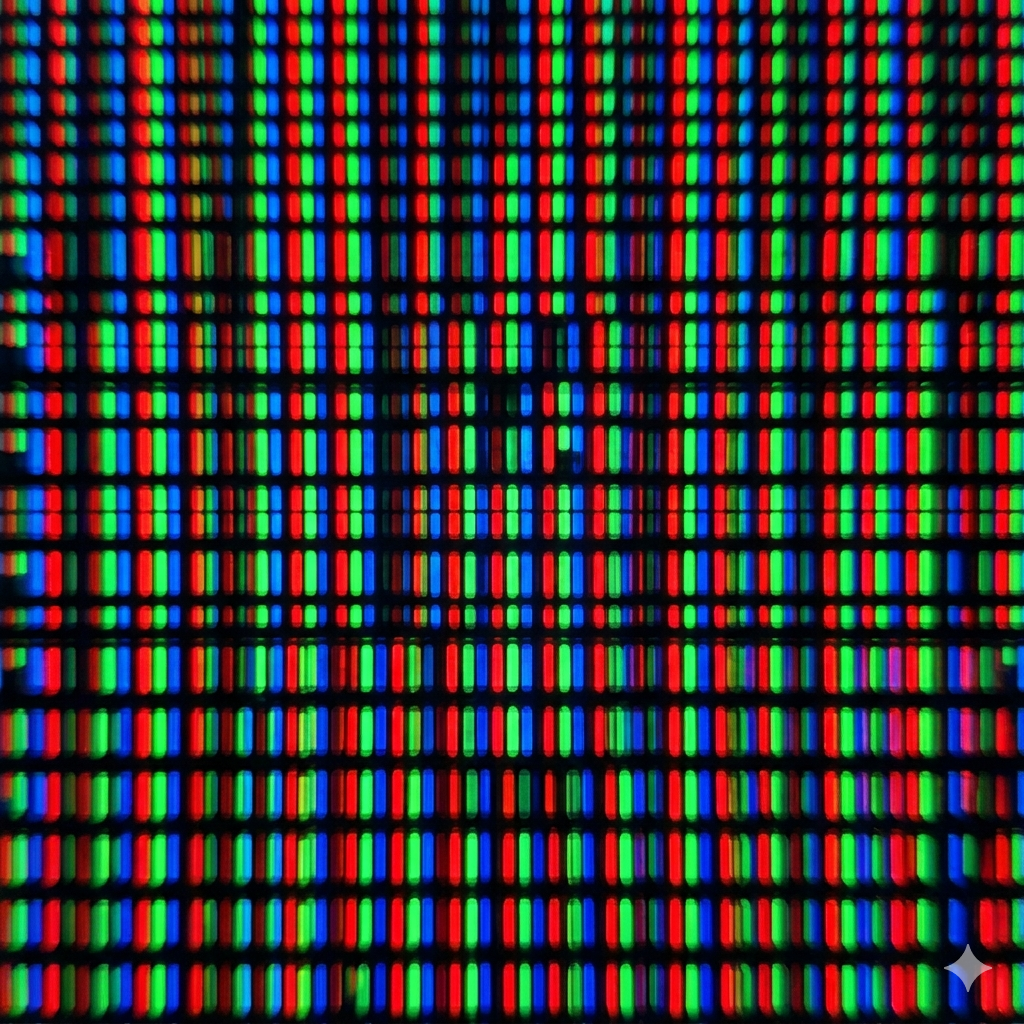
What declares itself is not for that reason carrying more potential than what does not. Legibility cuts both ways. The explicit is not automatically full. The decorative is not automatically empty. The line between them is not clean. The image sensor is a pattern, the physical grid that samples light at fixed intervals. The pixel is a pattern, the logical unit that the sampling produces. The generated image has neither sensor nor sampled light, only a calculated pattern that mimics what a sensor would have delivered. The substrate is patterned all the way down, whether the pattern is captured or computed.
The algorithm inherits this. It is a sequence of actions ordered in time, and in that respect it belongs to an old family that includes the weave, the recipe, the score, the liturgy. Each is a procedure written down so that it can be carried out, and each produces a recognisable result when followed. These traditions carry political histories of their own, of subordination and hierarchy, that bear on what the algorithm now does. Read formally, the algorithm is on the side of tradition and norm, a settled procedure whose virtue is that it returns the expected outcome. The procedure can also be a way of beginning without committing to an end. The shape of the algorithm, step and loop and wait and condition, is the shape of a procedure that can run without yet knowing what it will produce. Whether the procedure is held to the first use or the second is decided by how it is run and how it is read.
This shape is recognisable from the body. Heartbeat, breath, sleep, hunger, growth. Patterns of action in time, running with instructions so deeply held that they do not appear as instructions at all. Bodily rhythm is homeostatic. It returns in order to maintain, with no destination beyond continuation. Computational iteration as it is currently practised is more often loss-driven, returning in order to converge on a target, descending a gradient towards a minimum. The temporality is similar enough that the analogy carries, but the horizon of maintenance and the horizon of optimisation are not the same. Maintenance has no end-point. Optimisation does, even if it is never reached.
When the procedure is extracted from the body and written down, something is gained and something is lost. It becomes shareable, teachable, transmissible across materials and generations. The iterative quality, the overlap of each pass with the one before, is at risk of being read out, replaced by the appearance of clean repetition of the same. The written procedure looks identical on the page. Run in the world, it is always conditioned by what comes before it, what data it meets, what state the system is in. Each running arrives with a difference, and the differences accumulate in overlap rather than in sequence.
Pattern can therefore be a working method. It lets one begin without yet being able to say or show what one is making. The pattern is laid down, returned to, laid down again, and what emerges does so through the overlap rather than through a plan. This is closer to how thinking and making actually proceed than the narrative model that demands the end be imagined at the beginning. None of this is given by the pattern. It has to be done. And it can fail to be done in either direction, becoming decorative through inattention, becoming declarative through overcommitment to legibility, both of which can foreclose what the iterative work was for.
The settled and normative sense has its own pull. Once a procedure has been laid down often enough, it begins to look like the way things are, rather than one way among others. This is where algorithms slip from being patterns one works with into being patterns one is worked by. A feed that returns similar items, a model that generates images in a recognisable register, a recommendation that matches earlier choices. These are patterned, but read as natural regularities they pass for the way things must be. The grip of the documentary tradition is at work here, the long habit of treating the image as a window onto an apparent reality that lies behind it, asking the viewer to look through the surface to the depth it claims to deliver. The substrate, the sensor and the pixel and the procedure that produced it, is meant to disappear in the act of viewing. What is read is the depth, and the depth is taken to be real because the surface has been arranged to recede.
The vectors meeting at the image are not symmetrical. By the time the reader arrives, the procedure has been tilted by training distributions that selected what counted as a pattern, by loss functions that decided what counted as a good return, by compute constraints that shaped what could be iterated and at what cost, by the extraction economies that supplied the data and did their own selecting along the way. What the pattern allows and what the system steers are not the same, and the space between them is where the unruly reading has to operate.
This habit of treating depth as given rather than constructed has a long history, and the history is itself patterned. Brunelleschi’s churches in Florence, often invoked as the birth of perspective, made the constructed depth of the picture-space possible through the rhythmic interval of the columns and the modular repetition of the bays. The vanishing point that the eye reads as depth is calculated from the regular spacing of the architecture. Without the rhythm there is nothing for the eye to extrapolate from. The depth and the pattern were entwined from the beginning. What was named as the new thing, the rationalised picture-space, depended on something older that the same buildings made visible, the laying down of an interval that returns. The documentary frame has since learned to make this condition disappear, presenting the depth as if it were given rather than constructed from the rhythm beneath it. The forgetting is not only formal. The perspectival picture has been bound to particular regimes of cultural authority, and the rhythm beneath the depth has always been there, available to be read. The habit of looking through it rather than at it is a trained one. The grid of the columns and the grid of the pixels are not the same thing, but they do the same work. Both lay down a regular interval that the eye uses to construct the depth that the image then appears to deliver.
Image is used here as a reading surface rather than as a medium category. Painting, photography and the generated image are not the same kind of thing. They arrive from different technical systems, propose different relations to referent, ask different things of the eye. What they share is that meaning is made at their surface, and that the surface is patterned in ways the dominant reading has been trained to look through. The distinctions between these regimes matter and will be kept in view. The continuity between them is the surface itself, and the question of whether it is read or looked through.
The photographic image, in the dominant tradition, has been treated as finite and stable. It has a referent, a moment, a frame, a fixed relation to what was in front of the lens. The reading is bounded by that, even when the reading is sceptical of it. Critique of photography has largely worked within the same frame it is critiquing, taking the stability for granted and arguing about what the stability means, what it includes, what it leaves out, who is looking, who is looked at. The pattern of abstraction does not have that bounded character. It holds more wild reading because it does not propose a referent in the same way. It does not say this is what was there. It lays down a regularity and lets the reading move along it, return to it, find different things in different passes. The reading is not closed by the index. It is opened by the iteration.
The generated image sits between these. It looks like a photograph and is read at first through the photographic frame, with the same expectation of finitude and stability, the same demand for a referent. The procedure that produced it has no referent of that kind. It has a distribution, a sampling, a state, a sequence of decisions made by a system trained on patterns extracted from many images. The substrate here is not light or silver halide but math and weights, the patterned product of a procedure rather than the patterned record of an exposure. The output is closer to abstraction in its mode of generation, even when its surface mimics the photographic.
The procedure leaves traces of its own kind. Generative models tend to give everyone the same face, or close enough that the difference between faces collapses into a family resemblance the model has settled into. Crowds in the distance reduce to repeating units, the same head and shoulders tiled across the background where a photograph would have shown a thousand small differences. These are not failures of resolution. They are the procedure showing what it is doing, returning to what it has learned to return to, producing the average where the photographic frame would have produced the particular. Read as deficiency, they are reasons to dismiss the image. Read as pattern, they are where the procedure becomes visible as procedure.
What the generated image brings back into view is what was there at the origin of the documentary frame and was forgotten, the rhythm beneath the depth, the pattern that made the depth possible at all. The image enters under photographic credentials because its surface mimics the photographic, and reveals itself as worked surface because its making was patterned and iterative in a way the photographic frame cannot accommodate.
The dominant reading of images treats them as if they were text, with a fixed sequence of attention moving towards an end-point at which the meaning is delivered. The image as proposition, the surface as transparent vehicle for a content that lies behind it. What the image actually offers is a stage, on which many sequences of reading can be enacted, none of them required, none of them final. The brush stroke, the analog grain, the shape of the hand that held the camera, the pixel, the pattern of the sensor, each available as a place to dwell rather than a step on the way somewhere. The image is not a sentence to be completed. It is a surface laid out for return.
The image is too often accompanied by authoritative readings formulated as text that enclose the image and foreclose the misreadings that would otherwise be available. The wall label, the caption, the curatorial framing, the critical reading. The text tells the reader where to begin, what to find, when to stop. It removes the stage and replaces it with a script. The image becomes legible at the cost of being readable in only one way. If we want an unruly reader, one capable of setting the stage for themselves, the pattern has to be allowed to return, including in the forms that authoritative reading dismisses as faults. The strange perspective, the anatomy that does not resolve, the limb that doubles, the hand with too many fingers, the architecture that turns in on itself. These are usually called hallucinations and treated as failures of the procedure to produce a stable referent. Read through the documentary frame, they are errors. Read as pattern returning, they are openings. They are where the surface refuses to disappear into depth, where the iteration becomes visible as iteration. The fault is not in the image. The fault is in the demand for a stable referent that the procedure was never going to deliver.
The figurative documentary reading is valid. It does work. It organises evidence, grounds argument in shared reference, tells us things we need to know about what is in front of the lens or what the procedure was instructed to produce. The point is not to discard it. If it becomes the only mode of reading, if every image is asked to deliver a stable referent and every pattern is asked to declare what it represents, we lose the avenues of thought that the abstract and less directed patterns actually open. We remain trapped in the recognisable, and the recognisable is by definition what has already been admitted, what has already been given form, what has already been made legible by the frames currently in use. The abstract pattern, the unresolved figure, the iteration that does not converge on a category, are where reading might find what it does not yet know how to find. To exclude them in favour of the documentary mode is to limit thinking to what has already been thought. The figurative and the abstract are not opposed. They are both available, and the loss of either narrows what can be read and therefore what can be thought.
The same logic that organises the broader apparatus of suspicion has migrated into the art field’s own habits of address. The documentary and the didactic have become installed in the art field over the last decades, and the installation came in alongside a real push for inclusion, an attempt to make the field address publics that the older modernist frames had excluded and to bring in voices and histories that the autonomy of the work and the closed gesture of abstraction had not made room for. The wall label that explains, the caption that contextualises, the curatorial text that situates the artist’s stake, were responses to the elitism of the unannotated work. They answered a need. The cost of that answer is the didactic enclosure now operating as default. The image is expected to arrive with its reading attached. The pattern that does not declare itself, the abstraction that does not resolve into a position, the gesture that holds something open without naming what it holds, begins to look evasive, insufficiently accountable, suspect by virtue of its refusal to do explainable work. The art field, in trying to become more like the mainstream visual world, has imported some of the mainstream’s assumptions about what an image is for, and with them some of the mainstream’s habits of suspicion. The unruly reading survives against the institutional grain rather than with it. The inclusive impulse was right. Its institutionalisation has narrowed what the field can read. The avenues of thought the abstract pattern keeps open are not opposed to inclusion. They may be necessary to it, because what the existing vocabularies cannot yet read includes the experiences and possibilities that have not yet found their words.
If the unruly reading is to be more than a stance, it has to be practised in small gestures. Lingering on sensor noise rather than cropping it out. Showing multiple runs of the same prompt as a sequence rather than selecting the best one as the result. Treating the caption as one vector among many rather than as the authoritative key. Letting the hand with too many fingers stay in the image as a place to dwell rather than a defect to be fixed. Exhibiting the procedure alongside the output, the seed alongside the image, the prompt alongside the variations it produced. These are small refusals of the disappearance of the substrate. The unruly reading is built out of them, and they are available to anyone willing to keep the pattern in view. Without such a reader, the image that enters under photographic credentials and reveals itself as worked surface is repulsed at the gate, dismissed as defect, and the opening closes. The position to be moved beyond is the docile reader, the one the wall label produces, the one trained to take the script as the image. Docility is a product of the frame, not a failing of the reader, and the gestures are attempts to make a different reader possible, including in oneself.
These small gestures might also be where the position falsifies itself. The hand with too many fingers is noticed by almost everyone who looks at a generated image. The fault is common observation, not specialist insight. What is specialist is the move from noticing to reading, the willingness to dwell on the fault rather than dismiss it. If the unruly reading turns out to require training that only the field already provides, if the sensor noise and the seed and the variation sequence can only be read by readers who have already been initiated into looking at procedure, then the practical recommendations are weaker than they appear and the work of building the reader has barely begun. Whether the gestures travel beyond the people who already make them is the test. If they do not, the position is decorative in the sense it set out to refuse.
The faults are also a moving target. As models improve through better data curation, architectural changes, inference-time techniques and pre-prompting, the signature openings shrink. The image becomes more photographic, and in becoming more photographic it loses some of what the procedure was contributing. Those training the models often mistake photographic fidelity for what the algorithm might make visible, and engineer the openings shut in the name of improvement. The closures are not neutral. They move the generated image closer to the photographic frame the essay has been arguing the image is not. A position built on the hand with too many fingers will lose its material as the fingers resolve, and what replaces the fingers may be harder to read because the surface has been smoothed.
There is also a risk of romanticising the unresolved. Not every glitch is an opening. Sometimes a fault is just low-fidelity sampling and yields nothing. The value is not in the fault itself but in the relation between procedure and reading, the moments when the model’s inductive biases clash with what was asked of it, or when the user iterates visibly enough that the procedure stays in view. The small gestures recommended here keep the procedural nature visible. They do not guarantee that what the reading finds will be worth finding.
The algorithm is a sequence, and a sequence is a vector. It moves from one step to the next, it carries through, it has direction. The procedure is already going somewhere by virtue of being a procedure, even when what it produces is not yet known. Reading for pattern is also a vector, taken alongside, against, or across the one the procedure is running. The two are not the same motion. The procedure executes. The reading interprets. They meet at the image, and the image is what they share. To read for pattern is to keep the surface in view as the place where the vectors meet, rather than as the transparent layer one is supposed to look through. The illusion of depth is what allows the surface to do its work unread. The reader’s vector does not traverse freely. It intersects with the patterns of the image and travels along them, conditioned by what is there. The grain, the pixel, the strange anatomy, the unfinished perspective are not just available to be looked at, they are what the reading has to move through. What is left is the direction one takes across the patterns already laid down, and whether the reader returning to the patterned surface can keep returning when the institutional pull is to look through it instead.The Patterned Surface**
The word pattern carries two things at once. On one side, pattern is tradition and norm, the settled way, the recognisable form that has been laid down often enough to be expected. On the other, pattern is a form of abstraction that lets one begin something without yet knowing what it will be. To start a pattern is not to start a story. A story commits to its ending the moment it begins. A pattern allows a beginning that does not picture its end, because what it offers is return rather than arrival, iteration rather than conclusion. Both senses live in the word, and they pull in different directions. Being patterned is not in itself either of these. The image is a point at which several vectors meet. Production, the procedure that produced it. Presentation, the institutional frame that presents it. Reception, the reading that takes it up. Each of these depends on the image to make meaning, and the meanings they produce vary but are not arbitrary. What the image can be made to mean is constrained by what is in it, by the procedure that put it there, and by the reading that returns to it. Whether the pattern closes or opens depends on the vectors meeting at the surface, and on how each is travelled.
The opening sense is easily obscured. Pattern is often read through the decorative, used in the dismissive way the word has been made to carry, as if pattern were ornament, the visible regularity that pleases without arguing. The apolitical reading lets it stay there. Both privilege what declares itself, what is legible at first pass, and both can miss what abstraction does when it is given room, which is to hold open what cannot yet be put into words or images. The pattern that performs its own legibility has often given up the abstracting work and become illustration of what was thinkable already. The pattern that holds something open is harder to read, and that difficulty is the condition of its keeping anything open at all.
What declares itself is not for that reason carrying more potential than what does not. Legibility cuts both ways. The explicit is not automatically full. The decorative is not automatically empty. The line between them is not clean. The image sensor is a pattern, the physical grid that samples light at fixed intervals. The pixel is a pattern, the logical unit that the sampling produces. The generated image has neither sensor nor sampled light, only a calculated pattern that mimics what a sensor would have delivered. The substrate is patterned all the way down, whether the pattern is captured or computed.
The algorithm inherits this. It is a sequence of actions ordered in time, and in that respect it belongs to an old family that includes the weave, the recipe, the score, the liturgy. Each is a procedure written down so that it can be carried out, and each produces a recognisable result when followed. These traditions carry political histories of their own, of subordination and hierarchy, that bear on what the algorithm now does. Read formally, the algorithm is on the side of tradition and norm, a settled procedure whose virtue is that it returns the expected outcome. The procedure can also be a way of beginning without committing to an end. The shape of the algorithm, step and loop and wait and condition, is the shape of a procedure that can run without yet knowing what it will produce. Whether the procedure is held to the first use or the second is decided by how it is run and how it is read.
This shape is recognisable from the body. Heartbeat, breath, sleep, hunger, growth. Patterns of action in time, running with instructions so deeply held that they do not appear as instructions at all. Bodily rhythm is homeostatic. It returns in order to maintain, with no destination beyond continuation. Computational iteration as it is currently practised is more often loss-driven, returning in order to converge on a target, descending a gradient towards a minimum. The temporality is similar enough that the analogy carries, but the horizon of maintenance and the horizon of optimisation are not the same. Maintenance has no end-point. Optimisation does, even if it is never reached.
When the procedure is extracted from the body and written down, something is gained and something is lost. It becomes shareable, teachable, transmissible across materials and generations. The iterative quality, the overlap of each pass with the one before, is at risk of being read out, replaced by the appearance of clean repetition of the same. The written procedure looks identical on the page. Run in the world, it is always conditioned by what comes before it, what data it meets, what state the system is in. Each running arrives with a difference, and the differences accumulate in overlap rather than in sequence.
Pattern can therefore be a working method. It lets one begin without yet being able to say or show what one is making. The pattern is laid down, returned to, laid down again, and what emerges does so through the overlap rather than through a plan. This is closer to how thinking and making actually proceed than the narrative model that demands the end be imagined at the beginning. None of this is given by the pattern. It has to be done. And it can fail to be done in either direction, becoming decorative through inattention, becoming declarative through overcommitment to legibility, both of which can foreclose what the iterative work was for.
The settled and normative sense has its own pull. Once a procedure has been laid down often enough, it begins to look like the way things are, rather than one way among others. This is where algorithms slip from being patterns one works with into being patterns one is worked by. A feed that returns similar items, a model that generates images in a recognisable register, a recommendation that matches earlier choices. These are patterned, but read as natural regularities they pass for the way things must be. The grip of documentary habits is at work here, the long habit of treating the image as a window onto an apparent reality that lies behind it, asking the viewer to look through the surface to the depth it claims to deliver. The substrate, the sensor and the pixel and the procedure that produced it, is meant to disappear in the act of viewing. What is read is the depth, and the depth is taken to be real because the surface has been arranged to recede.
The vectors meeting at the image are not symmetrical. By the time the reader arrives, the procedure has been tilted by training distributions that selected what counted as a pattern, by loss functions that decided what counted as a good return, by compute constraints that shaped what could be iterated and at what cost, by the extraction economies that supplied the data and did their own selecting along the way. What the pattern allows and what the system steers are not the same, and the space between them is where the unruly reading has to operate.
This habit of treating depth as given rather than constructed has a long history, and the history is itself patterned. Brunelleschi’s churches in Florence, often invoked as the birth of perspective, made the constructed depth of the picture-space possible through the rhythmic interval of the columns and the modular repetition of the bays. The vanishing point that the eye reads as depth is calculated from the regular spacing of the architecture. Without the rhythm there is nothing for the eye to extrapolate from. The depth and the pattern were entwined from the beginning. What was named as the new thing, the rationalised picture-space, depended on something older that the same buildings made visible, the laying down of an interval that returns. The documentary frame has since learned to make this condition disappear, presenting the depth as if it were given rather than constructed from the rhythm beneath it. The forgetting is not only formal. The perspectival picture has been bound to particular regimes of cultural authority, and the rhythm beneath the depth has always been there, available to be read. The habit of looking through it rather than at it is a trained one. The grid of the columns and the grid of the pixels are not the same thing, but they do the same work. Both lay down a regular interval that the eye uses to construct the depth that the image then appears to deliver.
Image is used here as a reading surface rather than as a medium category. Painting, photography and the generated image are not the same kind of thing. They arrive from different technical systems, propose different relations to referent, ask different things of the eye. What they share is that meaning is made at their surface, and that the surface is patterned in ways much of the dominant reading has been trained to look through. The distinctions between these regimes matter and will be kept in view. The continuity between them is the surface itself, and the question of whether it is read or looked through.
The photographic image, in much of the dominant tradition, has been treated as finite and stable. It has a referent, a moment, a frame, a fixed relation to what was in front of the lens. The reading is bounded by that, even when the reading is sceptical of it. Critique of photography has largely worked within the same frame it is critiquing, taking the stability for granted and arguing about what the stability means, what it includes, what it leaves out, who is looking, who is looked at. The pattern of abstraction does not have that bounded character. It holds more wild reading because it does not propose a referent in the same way. It does not say this is what was there. It lays down a regularity and lets the reading move along it, return to it, find different things in different passes. The reading is not closed by the index. It is opened by the iteration.
The generated image sits between these. It looks like a photograph and is read at first through the photographic frame, with the same expectation of finitude and stability, the same demand for a referent. The procedure that produced it has no referent of that kind. It has a distribution, a sampling, a state, a sequence of decisions made by a system trained on patterns extracted from many images. The substrate here is not light or silver halide but math and weights, the patterned product of a procedure rather than the patterned record of an exposure. The output is closer to abstraction in its mode of generation, even when its surface mimics the photographic.
The procedure leaves traces of its own kind. Generative models tend to give everyone the same face, or close enough that the difference between faces collapses into a family resemblance the model has settled into. Crowds in the distance reduce to repeating units, the same head and shoulders tiled across the background where a photograph would have shown a thousand small differences. These are not failures of resolution. They are the procedure showing what it is doing, returning to what it has learned to return to, producing the average where the photographic frame would have produced the particular. The model returns what it has seen most often. Read as deficiency, these traces are reasons to dismiss the image. Read as pattern, they are where the procedure becomes visible as procedure.
What the generated image brings back into view is what was there at the origin of the documentary frame and was forgotten, the rhythm beneath the depth, the pattern that made the depth possible at all. The image enters under photographic credentials because its surface mimics the photographic, and reveals itself as worked surface because its making was patterned and iterative in a way the photographic frame cannot accommodate.
A dominant reading of images treats them as if they were text, with a fixed sequence of attention moving towards an end-point at which the meaning is delivered. The image as proposition, the surface as transparent vehicle for a content that lies behind it. What the image actually offers is a stage, on which many sequences of reading can be enacted, none of them required, none of them final. The brush stroke, the analog grain, the shape of the hand that held the camera, the pixel, the pattern of the sensor, each available as a place to dwell rather than a step on the way somewhere. The image is not a sentence to be completed. It is a surface laid out for return.
The image is too often accompanied by authoritative readings formulated as text that enclose the image and foreclose the misreadings that would otherwise be available. The wall label, the caption, the curatorial framing, the critical reading. The text tells the reader where to begin, what to find, when to stop. It removes the stage and replaces it with a script. The image becomes legible at the cost of being readable in only one way. If we want an unruly reader, one capable of setting the stage for themselves, the pattern has to be allowed to return, including in the forms that authoritative reading dismisses as faults. The strange perspective, the anatomy that does not resolve, the limb that doubles, the hand with too many fingers, the architecture that turns in on itself. These are usually called hallucinations and treated as failures of the procedure to produce a stable referent. Read through the documentary frame, they are errors. Read as pattern returning, they are openings. They are where the surface refuses to disappear into depth, where the iteration becomes visible as iteration. The fault is not in the image. The fault is in the demand for a stable referent that the procedure was never going to deliver.
The figurative documentary reading is valid. It does work. It organises evidence, grounds argument in shared reference, tells us things we need to know about what is in front of the lens or what the procedure was instructed to produce. The point is not to discard it. If it becomes the only mode of reading, if every image is asked to deliver a stable referent and every pattern is asked to declare what it represents, we lose the avenues of thought that the abstract and less directed patterns actually open. We remain trapped in the recognisable, and the recognisable is by definition what has already been admitted, what has already been given form, what has already been made legible by the frames currently in use. The abstract pattern, the unresolved figure, the iteration that does not converge on a category, are where reading might find what it does not yet know how to find. To exclude them in favour of the documentary mode is to limit thinking to what has already been thought. The figurative and the abstract are not opposed. They are both available, and the loss of either narrows what can be read and therefore what can be thought.
The same logic that organises the broader apparatus of suspicion has migrated into the art field’s own habits of address. The documentary and the didactic have become installed in the art field over the last decades, and the installation came in alongside a real push for inclusion, an attempt to make the field address publics that the older modernist frames had excluded and to bring in voices and histories that the autonomy of the work and the closed gesture of abstraction had not made room for. The wall label that explains, the caption that contextualises, the curatorial text that situates the artist’s stake, were responses to the elitism of the unannotated work. They answered a need. The cost of that answer is the didactic enclosure now operating as default. The image is expected to arrive with its reading attached. The pattern that does not declare itself, the abstraction that does not resolve into a position, the gesture that holds something open without naming what it holds, begins to look evasive, insufficiently accountable, suspect by virtue of its refusal to do explainable work. The art field, in trying to become more like the mainstream visual world, has imported some of the mainstream’s assumptions about what an image is for, and with them some of the mainstream’s habits of suspicion. The unruly reading survives against the institutional grain rather than with it. The inclusive impulse was right. Its institutionalisation has narrowed what the field can read. The avenues of thought the abstract pattern keeps open are not opposed to inclusion. They may be necessary to it, because what the existing vocabularies cannot yet read includes the experiences and possibilities that have not yet found their words.
If the unruly reading is to be more than a stance, it has to be practised in small gestures. Lingering on sensor noise rather than cropping it out. Showing multiple runs of the same prompt as a sequence rather than selecting the best one as the result. Treating the caption as one vector among many rather than as the authoritative key. Letting the hand with too many fingers stay in the image as a place to dwell rather than a defect to be fixed. Exhibiting the procedure alongside the output, the seed alongside the image, the prompt alongside the variations it produced. These are small refusals of the disappearance of the substrate. The unruly reading is built out of them, and they are available to anyone willing to keep the pattern in view. Without such a reader, the image that enters under photographic credentials and reveals itself as worked surface is repulsed at the gate, dismissed as defect, and the opening closes. The position to be moved beyond is the docile reader, the one trained to take the script as the image, formed by the wall label and by every other frame that arrives with the reading already attached. Docility is a product of the framing, not a failing of the reader, and the gestures are attempts to make a different reader possible, including in oneself.
These small gestures might also be where the position falsifies itself. The hand with too many fingers is noticed by almost everyone who looks at a generated image. The fault is common observation, not specialist insight. What is specialist is the move from noticing to reading, the willingness to dwell on the fault rather than dismiss it. If the unruly reading turns out to require training that only the field already provides, if the sensor noise and the seed and the variation sequence can only be read by readers who have already been initiated into looking at procedure, then the practical recommendations are weaker than they appear and the work of building the reader has barely begun. Whether the gestures travel beyond the people who already make them is the test. If they do not, the position is decorative in the sense it set out to refuse.
The faults are also a moving target. As models improve through better data curation, architectural changes, inference-time techniques and pre-prompting, the signature openings shrink. The image becomes more photographic, and in becoming more photographic it loses some of what the procedure was contributing. Those training the models often mistake photographic fidelity for what the algorithm might make visible, and engineer the openings shut in the name of improvement. The closures are not neutral. They move the generated image closer to the photographic frame the essay has been arguing the image is not. A position built on the hand with too many fingers will lose its material as the fingers resolve, and what replaces the fingers may be harder to read because the surface has been smoothed.
There is also a risk of romanticising the unresolved. Not every glitch is an opening. Sometimes a fault is just low-fidelity sampling and yields nothing. The value is not in the fault itself but in the relation between procedure and reading, the moments when the model’s inductive biases clash with what was asked of it, or when the user iterates visibly enough that the procedure stays in view. The small gestures recommended here keep the procedural nature visible. They do not guarantee that what the reading finds will be worth finding.
The algorithm is a sequence, and a sequence is a vector. It moves from one step to the next, it carries through, it has direction. The procedure is already going somewhere by virtue of being a procedure, even when what it produces is not yet known. Reading for pattern is also a vector, taken alongside, against, or across the one the procedure is running. The two are not the same motion. The procedure executes. The reading interprets. They meet at the image, and the image is what they share. To read for pattern is to keep the surface in view as the place where the vectors meet, rather than as the transparent layer one is supposed to look through. The illusion of depth is what allows the surface to do its work unread. Reading is returning. The reader’s vector does not traverse freely. It intersects with the patterns of the image and travels along them, conditioned by what is there. The grain, the pixel, the strange anatomy, the unfinished perspective are not just available to be looked at, they are what the reading has to move through. What is left is the direction one takes across the patterns already laid down, and whether the reader returning to the patterned surface can keep returning when the trained habit, the rehearsed norm, the institutional pull are all working to look through it instead.