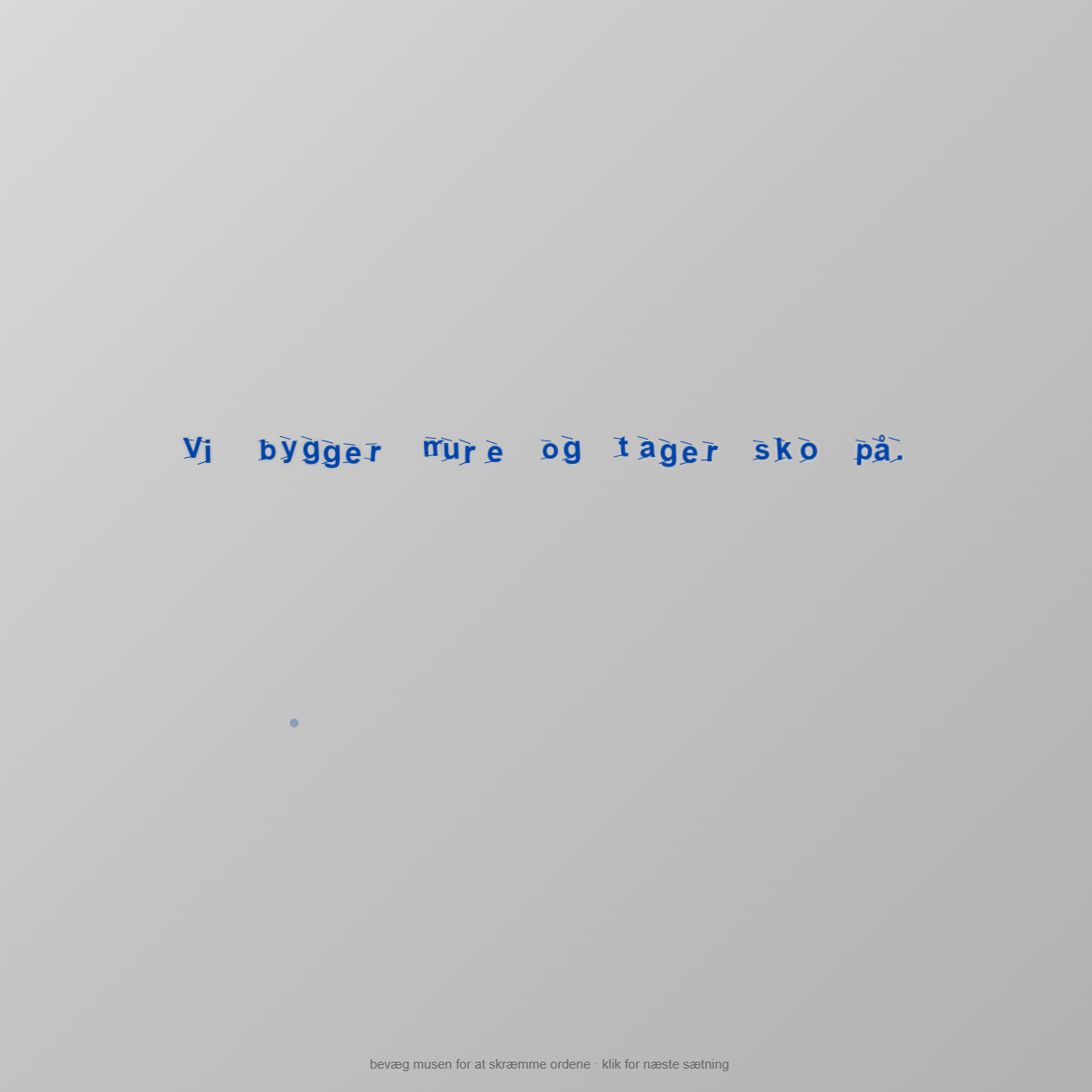
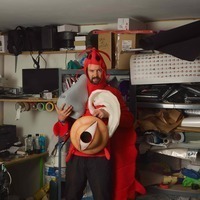
My interactive text piece features words that crawl in from the edges of the screen to form sentences at its centre. Each letter has legs that animate as it moves. The words scatter when you touch them, fleeing from the cursor, then slowly return to their positions when left alone. Click, and they fade as they crawl back toward the edges, making way for the next sentence. The work is part of Leddyrsomsorg, a project imagining a future Danish healthcare system where giant blue woodlice replace AI and automation. The crawling text contrasts human separation from the world with the woodlouse’s integration into it. We build walls, wear shoes, make surfaces easy to clean. The woodlouse turns toward the world. We become ill from what we create. The woodlouse carries heavy metals in its body, bearing what we cannot tolerate. We drink through glass. The woodlouse draws moisture directly through tubular legs. Each sentence proposes that the boundaries we construct—between clean and dirty, inside and outside, self and environment—are boundaries the woodlouse does not recognise. The words arrive from beyond the visible frame, assemble themselves into readable lines, then disperse when disturbed. This is a small model of how meaning gathers and scatters, how language crawls toward coherence only to flee when examined too closely, how sentences are temporary congregations of smaller creatures. The final sentence in the rotation states: This text is about the woodlouse. But the woodlouse is not about this text. It crawls on under the stone, indifferent to my considerations. The interface uses vanilla JavaScript with no external libraries. Each letter is a separate DOM element with animated legs. Letter positions blend between spread formation for readability and trailing formation during movement. Individual letters scatter from touch independently of their word. Words meander as they approach their targets, never travelling in straight lines. All processing runs client-side. Available in both Danish and English. oerum.org